user guide
Welcome to the comprehensive user guide for Corral — the unified management platform for virtual machines, pet-pod containers, and local hypervisors.
Backends, contexts, and peers
corral config set-default-backend incus makes unqualified creates use
Incus. corral context list|set|get switches Corral's context without
mutating kubectl or the Incus CLI; --context is a one-shot override.
Libvirt URIs make remote QEMU a normal backend, for example:
corral context set qemu+ssh://hypervisor/system.
A local dashboard can aggregate an in-cluster Corral without a local
kubeconfig: corral peer add homelab https://corral.example.ts.net.
Console routing tries the VM's advertised direct address first and relays
through the peer only when direct access is unavailable.
1. Overview & Architecture
Corral brings together diverse virtualization and container workloads under a single interface, CLI, and Tailscale network.
flowchart TD
    User([User / CLI / Web UI]) --> Corral[Corral Core]

    subgraph Backends
        Corral --> QEMU[QEMU / KVM Local]
        Corral --> KubeVirt[KubeVirt / Kubernetes]
        Corral --> CT[Pet-Pod CT / K8s]
        Corral --> Incus[Incus / LXC and VMs]
        Corral --> Libvirt[libvirt local or SSH URI]
        Corral --> Proxmox[Proxmox VE cluster]
        Corral --> Peer[Remote Corral peer]
    end

    subgraph Access Layer
        QEMU --> Tailnet[Tailscale Tailnet]
        KubeVirt --> Tailnet
        CT --> Tailnet
        Incus --> Tailnet
        Libvirt --> Tailnet
        Proxmox --> Tailnet
        Peer --> Tailnet
    end
Supported Compute Backends
| Backend | Scope | Tech Stack | Use Case |
|---|---|---|---|
| QEMU | Local Host | QEMU / KVM + systemd | Fast, local ephemeral or dev VMs on your workstation |
| KubeVirt | Cluster | KubeVirt + Kubernetes | Production VMs with live migration, PVC storage, and scaling |
| Container (CT) | Cluster | Kubernetes Pod + PVC | "Pet Pods" — persistent Linux containers (Distrobox on K8s) |
| Incus | Local or remote | Incus remote | Containers and VMs managed through existing Incus trust |
| libvirt | Local or remote | libvirt URI / OpenSSH | Existing domains and remote QEMU hypervisors |
| Proxmox VE | Cluster | Proxmox VE HTTPS REST API | VMs and LXC containers managed on existing PVE clusters |
2. Interactive Interfaces
Web Dashboard
Access the Proxmox-style Web UI at http://localhost:8006 or via corral web.
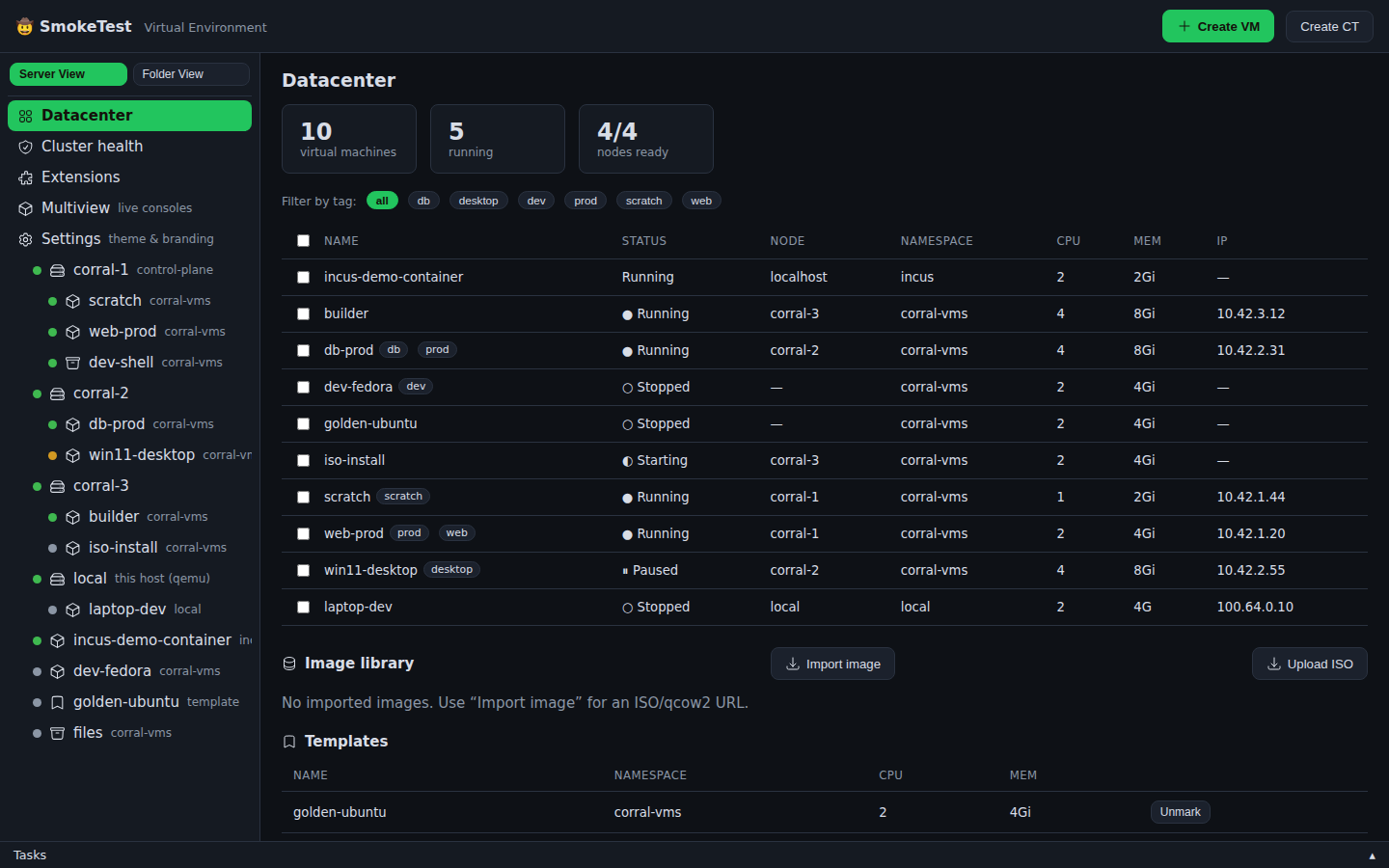
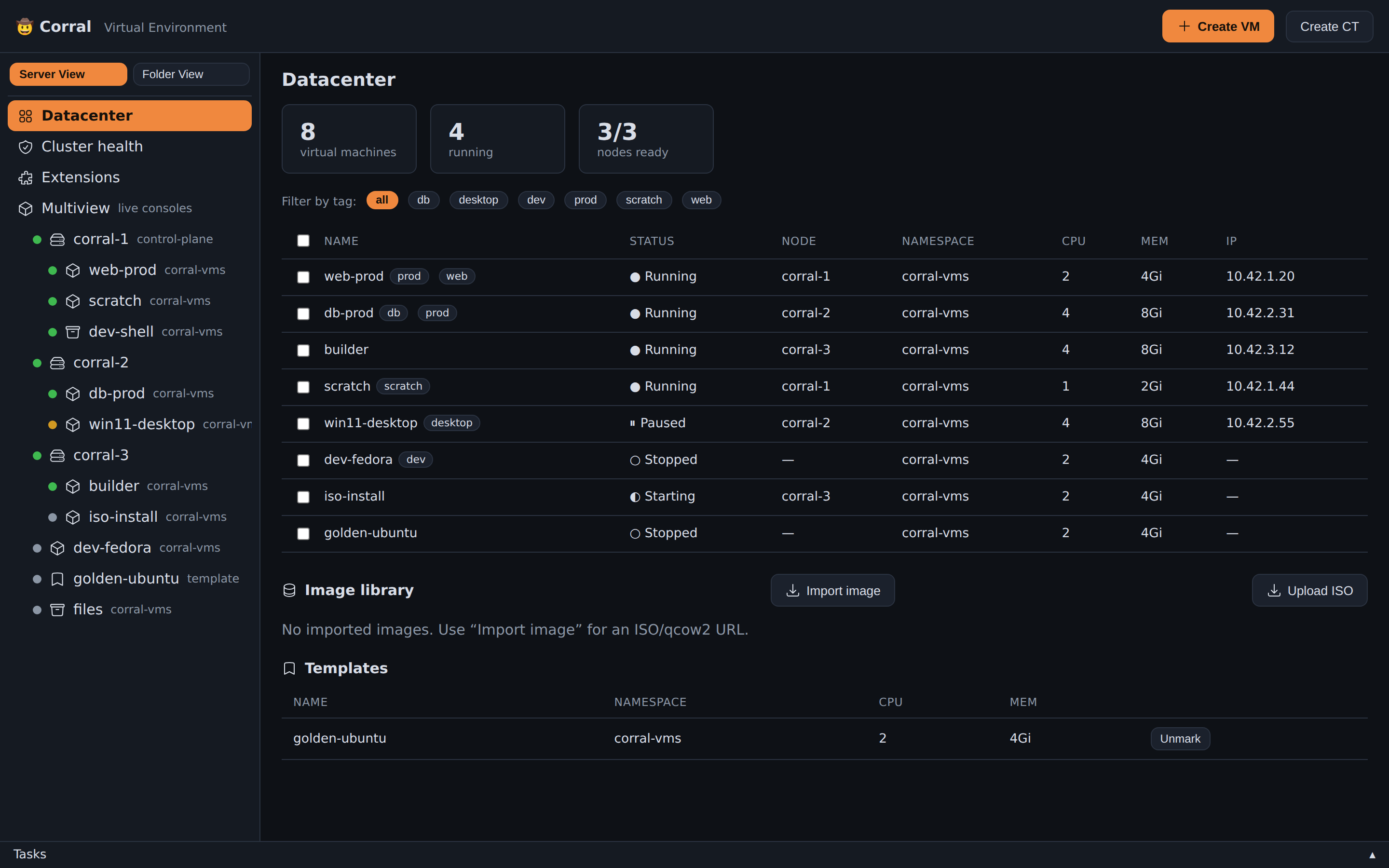
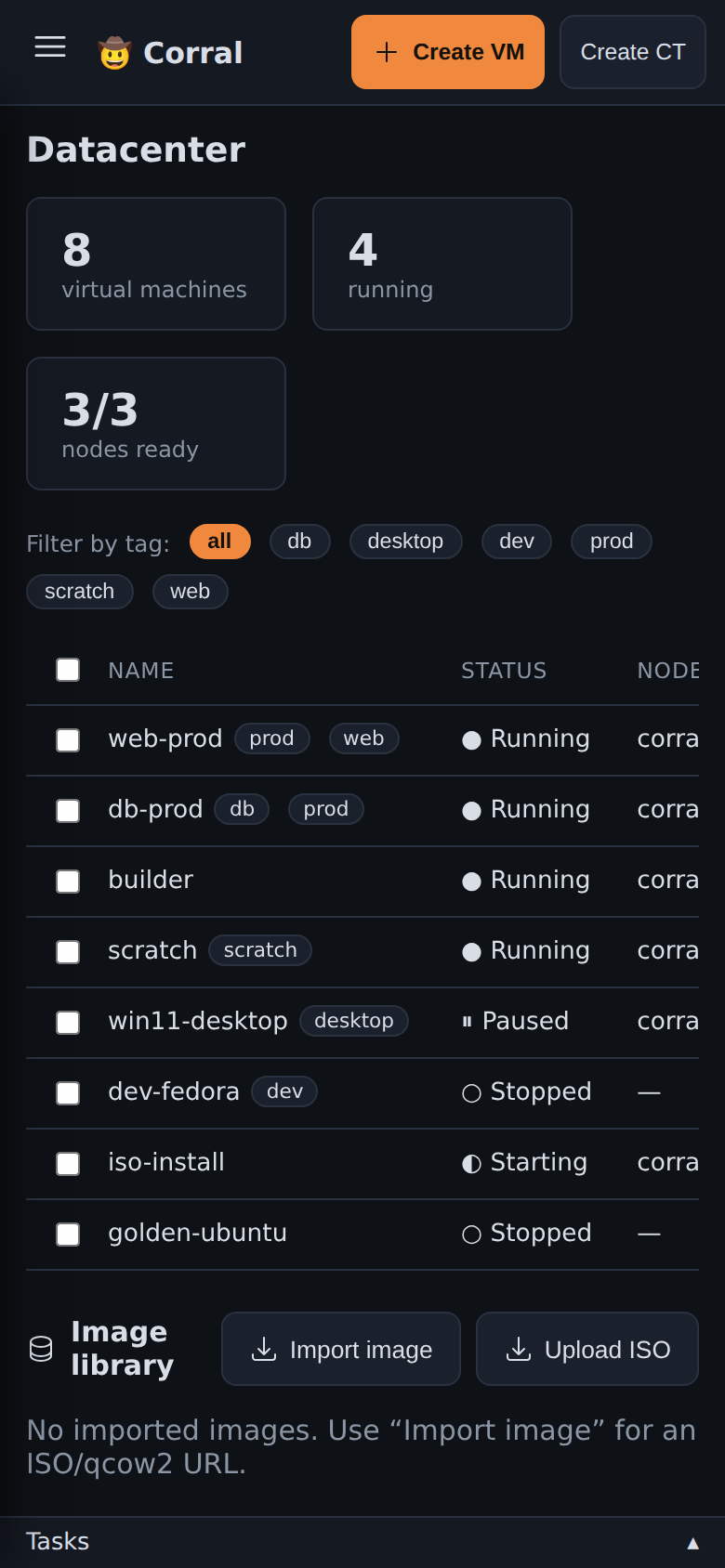
Features:
- Datacenter Tree: Navigate through all VMs, CTs, and Incus instances across local and cluster nodes.
- Live CPU & Memory Sparklines: Real-time load monitoring per VM.
- Tag Filtering: Filter instances by custom tags (
prod,dev,desktop). - Mobile Responsive: Manage your VM fleet from your mobile browser.
- Theme & Branding: Customize accent colours, header branding, and inject custom CSS — via CLI flags, config file, or the built-in Settings page.
Theme & Branding
Corral's web UI accent colour, header branding, and custom CSS are fully customizable — no source-code changes needed.
CLI flags (highest priority, override everything):
corral web --accent \"#3b82f6\" --brand-title \"My Lab\" --brand-emoji \"⚡\" --brand-subtitle \"Engineering\"
Config file (~/.config/corral/config.yaml, loaded on startup):
web:
  accent: \"#22c55e\"        # CSS hex colour
  accent_2: \"#16a34a\"      # hover/active variant
  brand_title: \"My Lab\"
  brand_emoji: \"⚡\"
  brand_subtitle: \"Engineering\"
  custom_css: |
    .btn.primary { border-radius: 20px; }
    .card { background: var(--panel-2); }
Settings page (web UI → Settings in the sidebar):
- Colour picker with preset swatches (Orange, Blue, Green, Purple, Red, Amber)
- Brand title, emoji, and subtitle fields with live header preview
- Custom CSS textarea that injects styles immediately as you type
- Save button persists to
config.yaml
Precedence: CLI flags > config.yaml > built-in defaults (🤠 Corral, orange accent).
Terminal UI (TUI)
Launch the interactive Bubble Tea TUI by running corral with no arguments (or explore in demo mode with corral --demo).
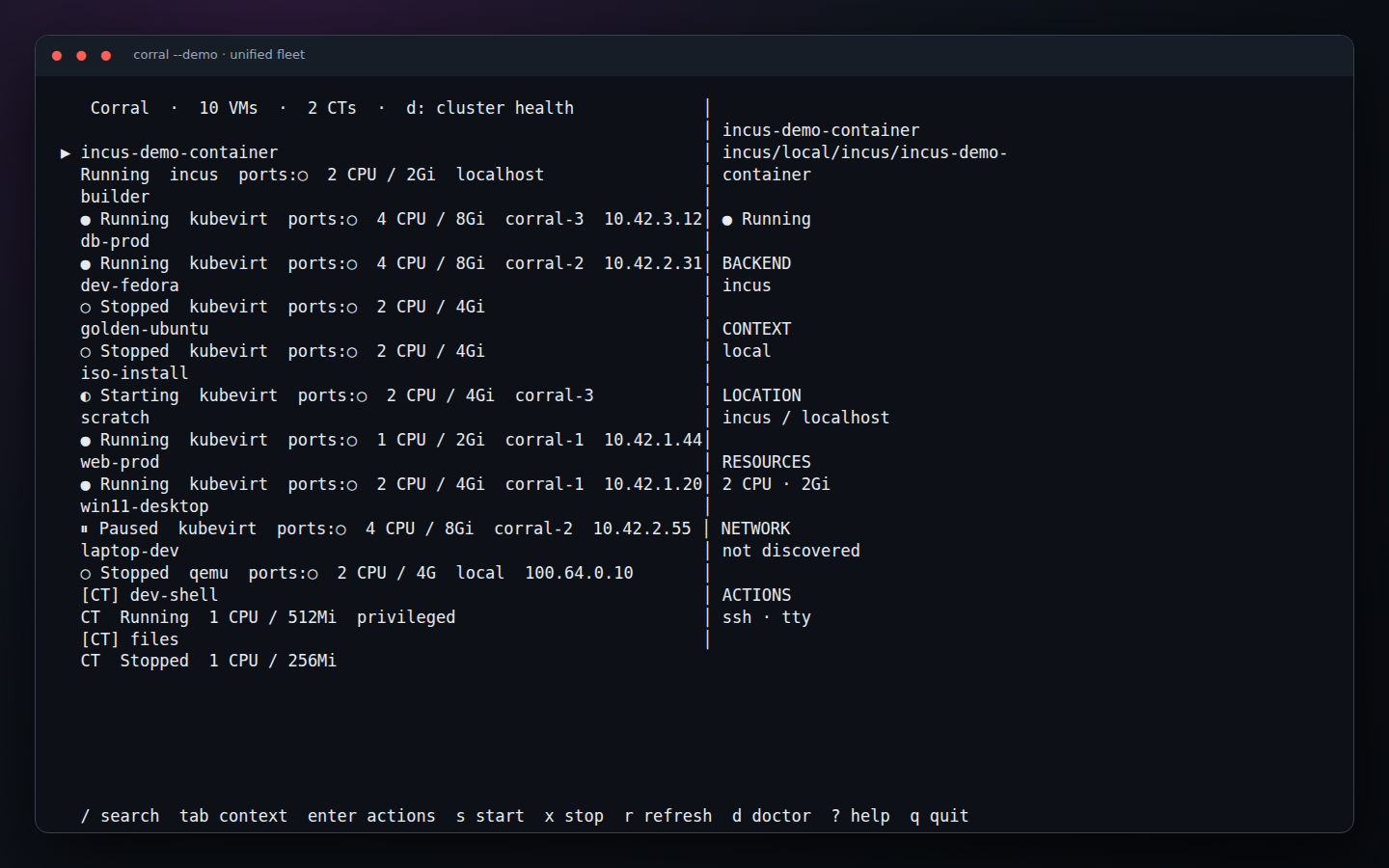
The left side is a unified, searchable fleet. Wide terminals add a details pane with canonical ID, backend/context, placement, address, resources, and available operations. Failed remotes appear as partial-fleet warnings without hiding healthy instances.
TUI keyboard shortcuts and features
/fuzzy-searches names, canonical IDs, backends, contexts, nodes, and IPs.Tab,[and]cycle between the complete fleet and named contexts.Enteropens a capability-aware action menu; unsupported operations are absent rather than failing after selection. Power (start/stop/restart/ pause/resume), migrate, clone, snapshots, events, the template mark, CPU/RAM, published ports, export, SSH, VNC, and delete all live there.- Snapshots opens the instance's captures:
ntakes one (named or auto-named),Enterrestores,xdeletes,rreloads. Every backend that can snapshot is supported — KubeVirt, libvirt, Incus, and local QEMU — and each capture reports what it actually caught (offline, filesystem, or crash-consistent), same as the web UI's Snapshots tab. - Events shows the recent Kubernetes events for a KubeVirt VM and its
virt-launcherpod, newest first. - Make/Unmark template flips the golden-template label that
corral clonecopies from. - CTs get their own smaller menu — start, stop, console, CPU/RAM, delete.
sandxquickly start or stop the selected VM;rrefreshes every backend.druns scoped QEMU, KubeVirt, Incus, and libvirt diagnostics.- The mouse works too: click a row to select it, double-click to open its actions (or to run the highlighted one), and scroll with the wheel. Clicking a port row in the ports form toggles it. Destructive actions still go through their confirmation — a double click can't reach anything a keypress can't.
?opens the in-app command deck.- QEMU, KubeVirt, Incus, libvirt, and pet-pod CTs share the inventory without losing their backend-specific capabilities.
3. Core Feature Walkthrough
1. Instance Lifecycle Management
Create and manage instances across any backend with identical commands:
# Create local QEMU VM
corral create dev-vm --iso https://example.com/ubuntu.iso --disk 40G

# Create KubeVirt cluster VM
corral create prod-vm --kubevirt --image fedora

# Create on an existing Incus remote
corral create fast-ct --backend incus --context lab --image images:ubuntu/22.04

# Universal operations
corral start dev-vm
corral stop dev-vm
corral delete dev-vm
2. Remote Access: VNC, RDP & TTY
Corral provides single-command remote access to guest displays and shells:
In-Browser & Local VNC
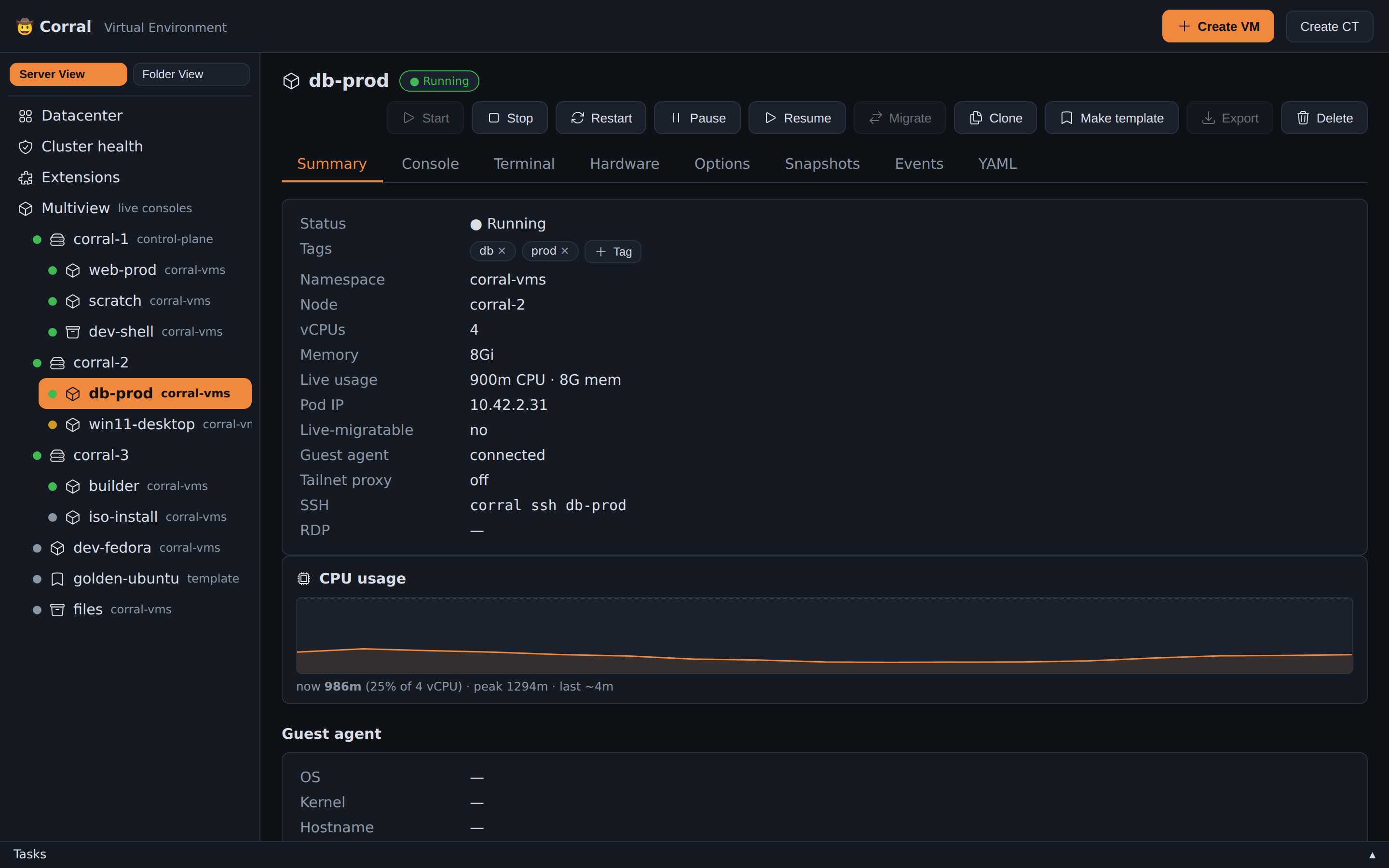
- VNC Display:
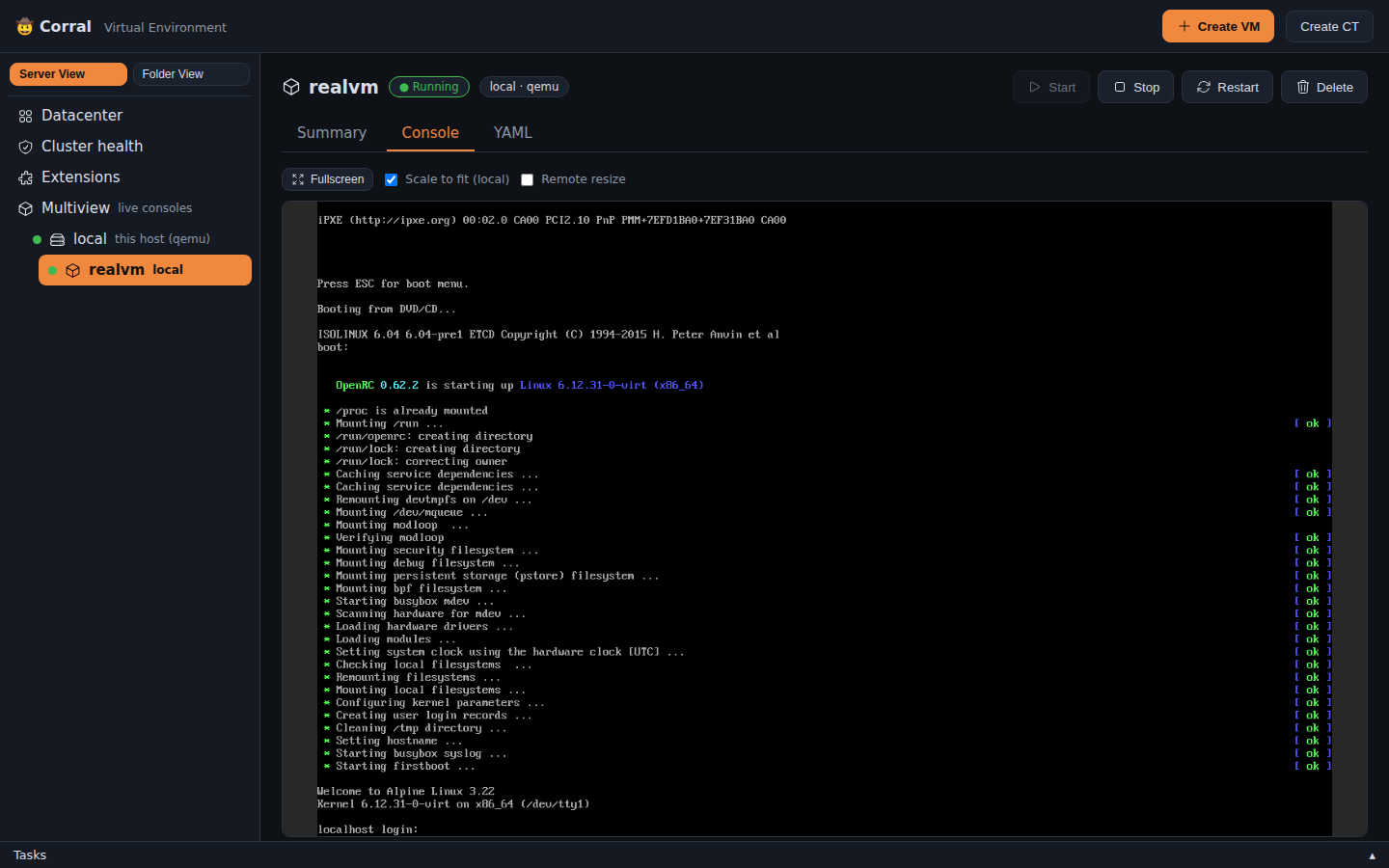
corral viewer <vm-name>opens a VNC session. In the Web UI,noVNCprovides zero-install browser display access. - Interactive TTY / SSH:
corral ssh <vm-name>orcorral tty <ct-name>connects your terminal directly into guest shell namespaces (via SSH,virtctl console, orincus exec).
3. Bootable Container Images (bootc)
Boot containers directly as VMs using the bootc plugin:
corral plugin install bootc
corral bootc create my-node --image quay.io/centos-bootc/centos-bootc:stream9
- Builds a bootable OS disk on-cluster using
bootc install to-disk. - Upgrade guest OS images using
corral bootc upgrade <vm-name>.
4. Proxmox VE API Compatibility Layer
Corral includes a Proxmox VE REST API emulation layer (/api2/json/...), allowing Terraform (bpg/proxmox), Ansible, and Proxmoxer tools to manage KubeVirt and Incus instances natively.
corral plugin install proxmox
corral proxmox serve --addr :8006
5. Plugin Marketplace
Expand Corral with lightweight marketplace plugins:
# Browse marketplace
corral plugin search

# Installed plugins
corral plugin list

# Plugin management
corral plugin install <name>
corral plugin remove <name>
Available Plugins:
bootc: Bootable container image VM builder.proxmox: Proxmox VE REST API compatibility server.backup: S3/R2 VM disk backup & restore.snapsched: Automated VM snapshot schedules with retention rules.schedule: VM autostart and shutdown cron windows.gpu: GPU / PCI passthrough device plugin discovery.windows: First-class Windows VM creation (UEFI, TPM, virtio drivers).vdi: Virtual Desktop Infrastructure desktop pools.
4. Diagnostics & Troubleshooting
Run corral doctor to diagnose cluster capabilities, hypervisor support, and storage drivers:
corral doctor
In a multi-context setup it diagnoses every configured QEMU, KubeVirt, Incus,
libvirt, and Proxmox target. Use corral doctor --context NAME for one target. The
complete capability matrix and direct-versus-relayed networking behavior are
documented in backend-support.md.
✓ KubeVirt installed (v1.8.2)
✓ CDI containerized data importer available
✓ Default StorageClass supports volume expansion
✓ VolumeSnapshotClass available for backups
✓ QEMU KVM hardware acceleration (/dev/kvm) accessible
✓ Incus daemon socket (/var/lib/incus/unix.socket) active
Reproducible screenshots
Documentation captures use the real built-in demo fleet. They are automated for both Chromium and the Bubble Tea TUI:
npm install --prefix e2e
node scripts/capture-docs.mjs docs/screenshots/generated
The same command can target the TunaOS site checkout:
node scripts/capture-docs.mjs ../docs/static/img/screenshots/corral.