index
Herd your VMs — and containers — into your tailnet.
Your VMs have escaped. Quick ones on your laptop, big ones on the Kubernetes cluster in the closet, an Incus server that's too useful to replace, a libvirt host that answers over SSH, a Proxmox node you never got around to retiring. Five sets of tooling, five networking stories, and none of it reachable from the couch.
Corral fixes that. One command, every backend — local QEMU/KVM, KubeVirt, Incus, libvirt, Proxmox VE, or a federated Corral peer — and every VM lands inside the one network all your devices already share — your Tailscale tailnet.
corral create web --kubevirt --container-disk quay.io/containerdisks/fedora:42
corral ssh web        # from this machine, your laptop, or your phone's terminal
VMs are cattle. Stop treating each one like a networking project.
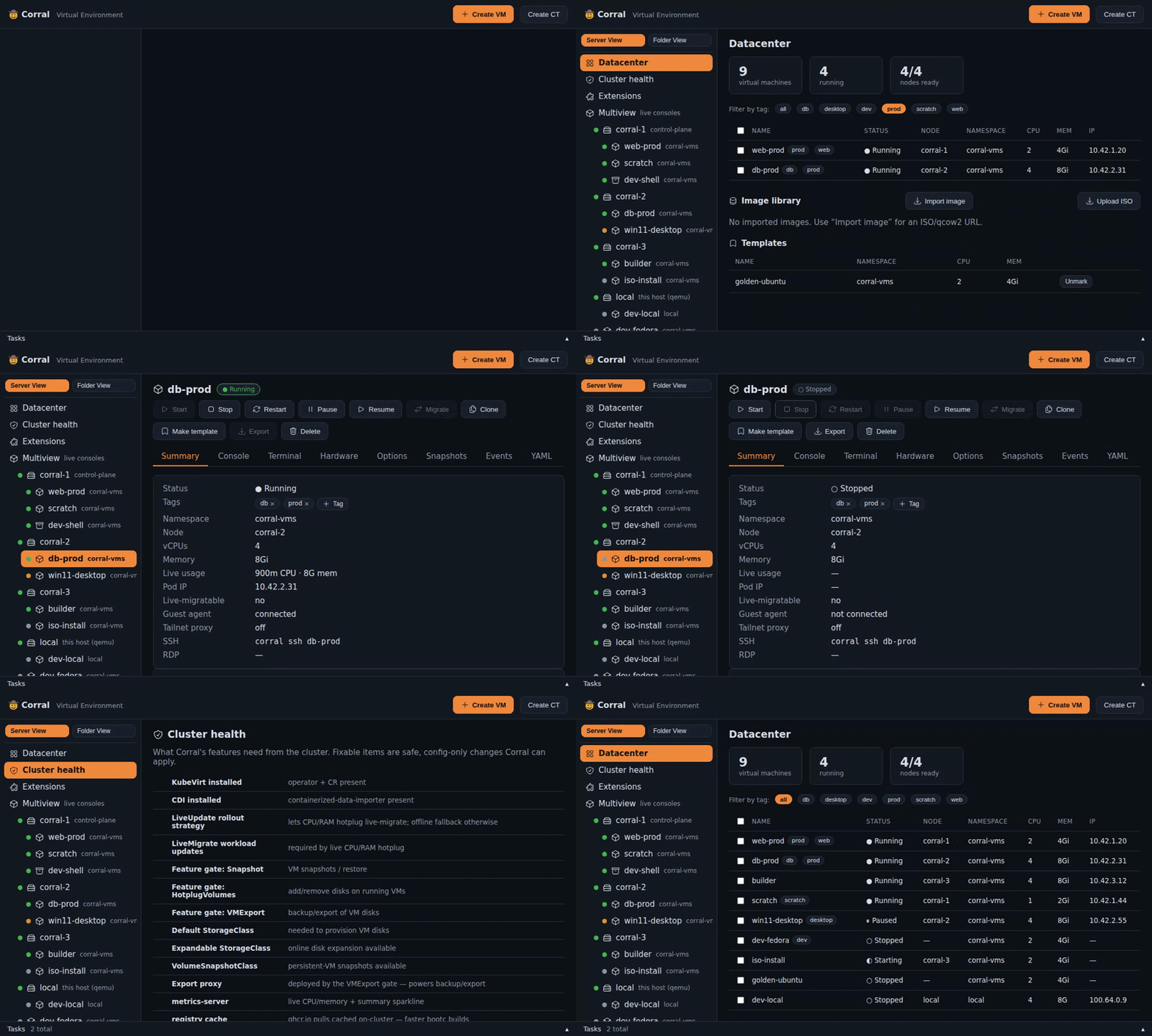
↑ that's corral web --demo — try the whole dashboard yourself in 30 seconds, no cluster needed.
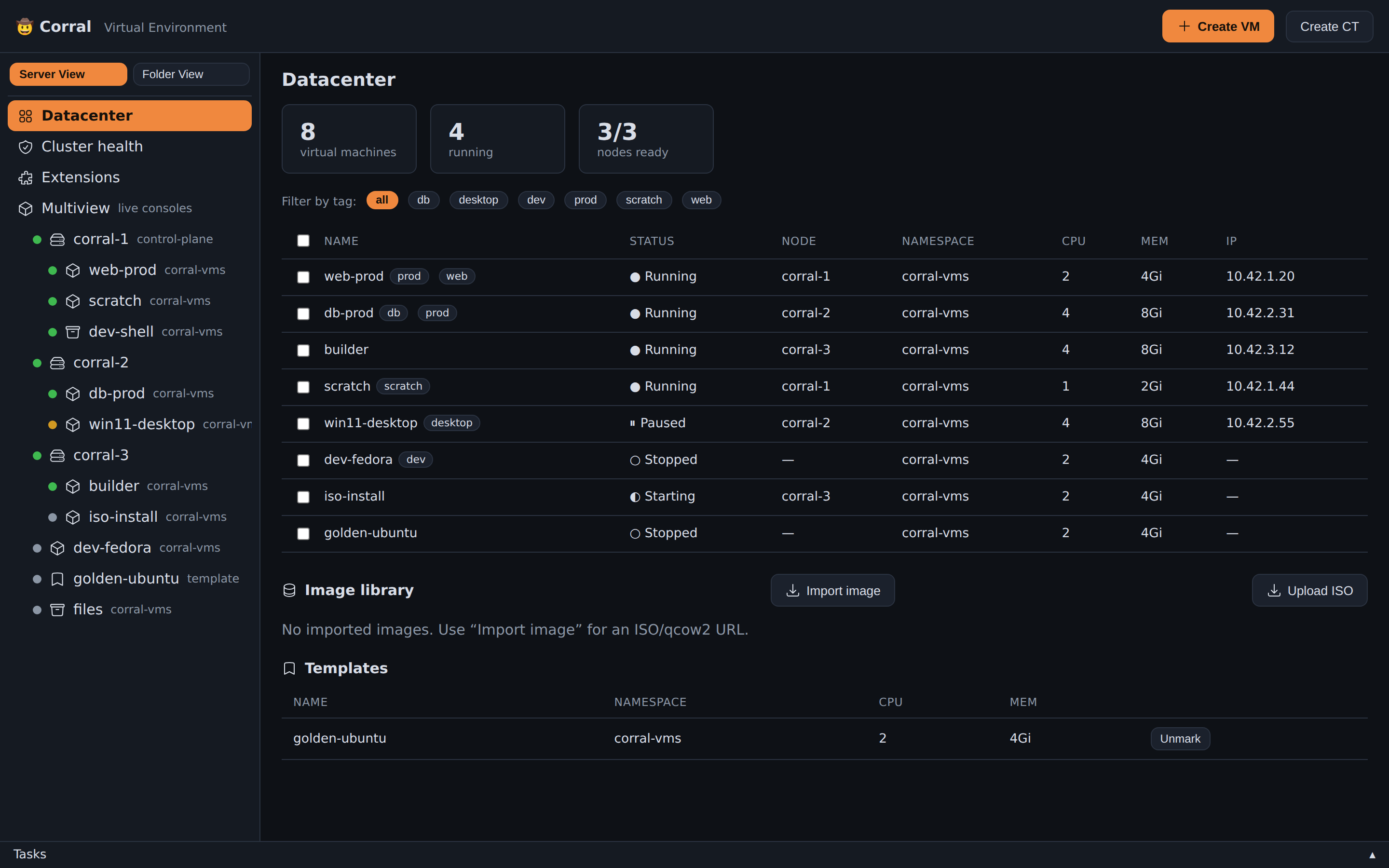
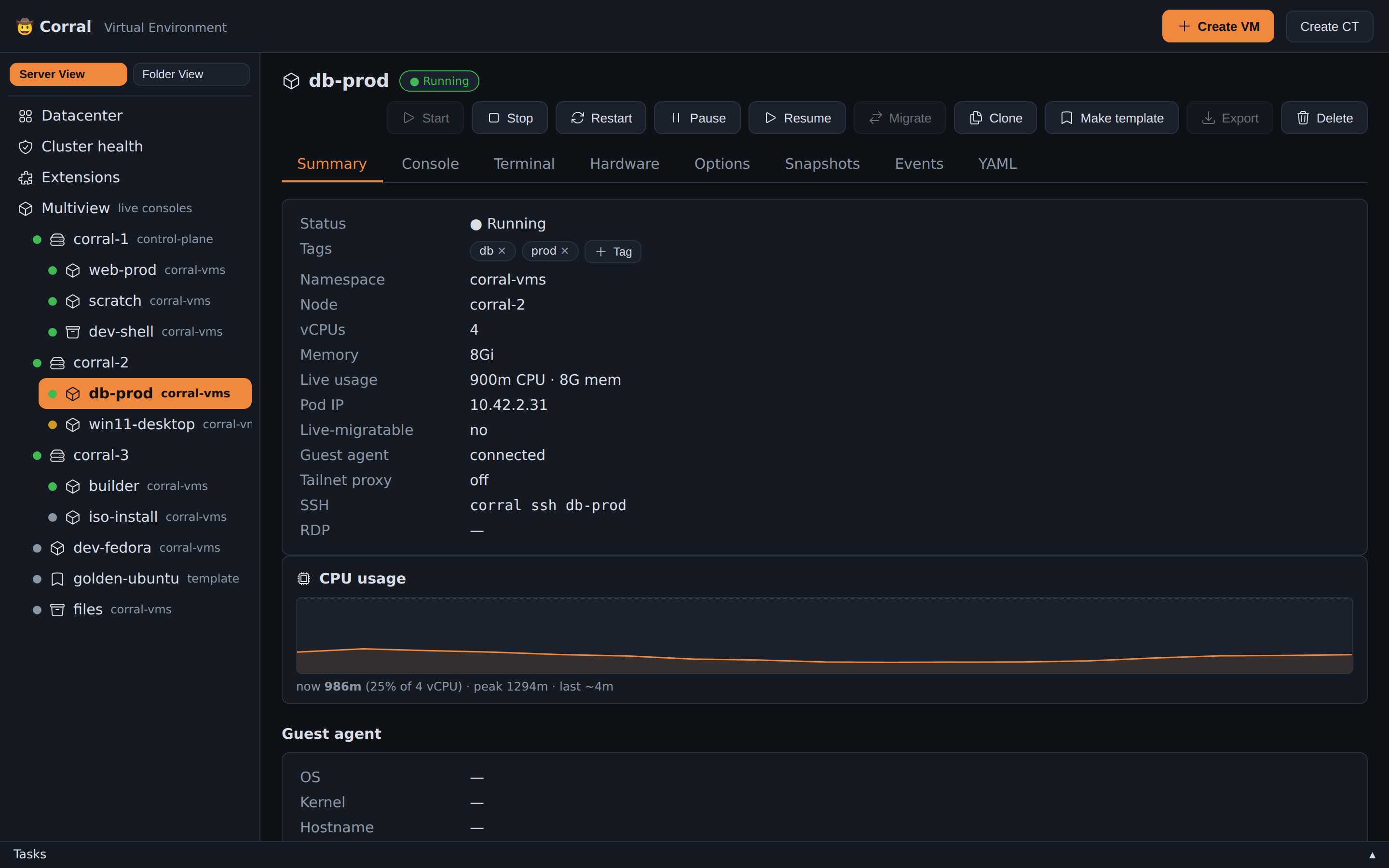
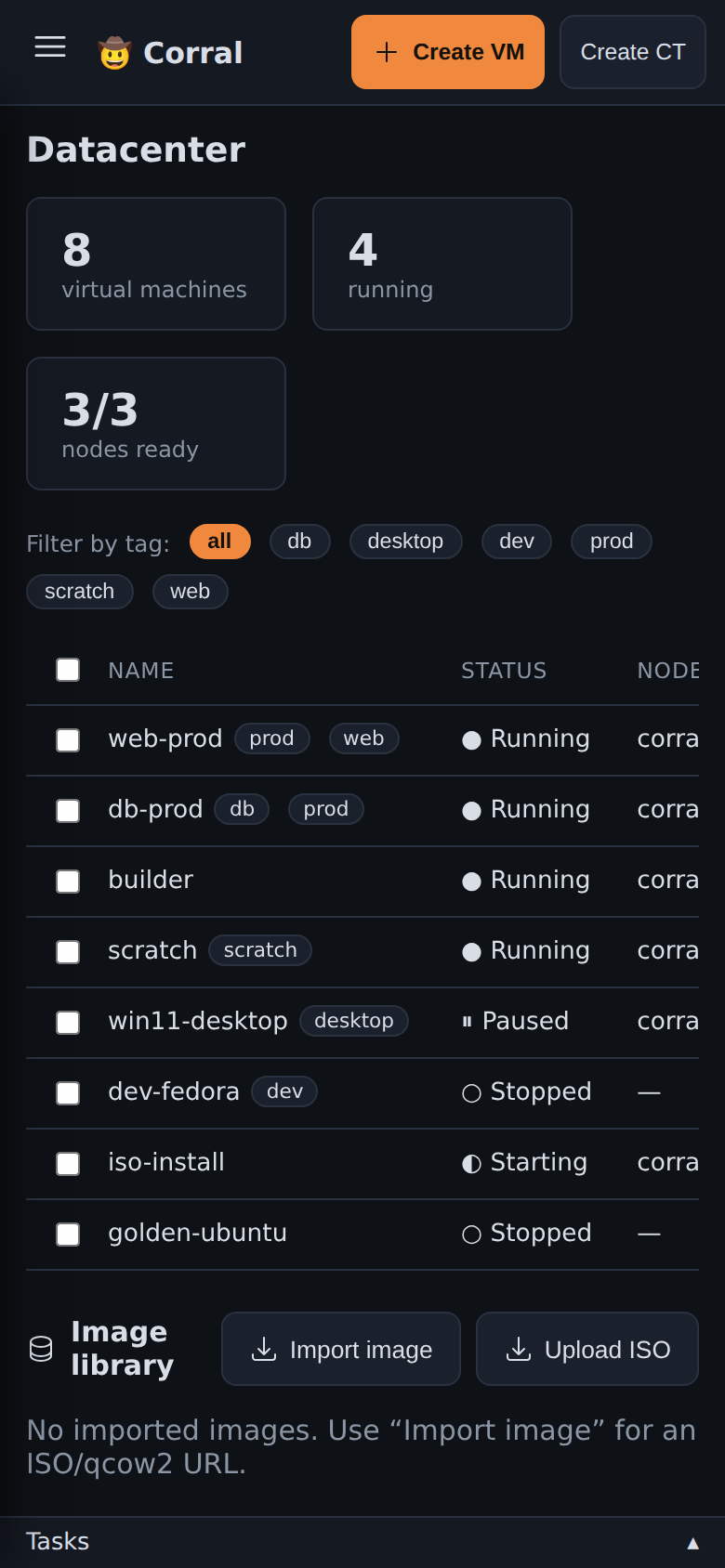
Screenshots: datacenter view, VM summary with live CPU, mobile view
Why you'll like it
- Same commands everywhere.
create/start/ssh/viewer/clone/deletework identically across every backend context — local QEMU/KVM, KubeVirt on your cluster, Incus, libvirt, or a federated Corral peer (advertised/direct guest endpoints first, HTTP/WebSocket relay as fallback — see backend support matrix). Corral remembers which is which — you never specify it again. - One fleet, not five tabs. Every configured context is aggregated at
once:
corral list, the TUI and the dashboard show the whole fleet, andcorral context use NAMEonly chooses where new work lands — it never hides the rest, and it never mutates kubectl's or Incus's own global config. Authentication stays boring on purpose: an existing Incus remote's trust, aqemu+ssh://URI through your OpenSSH agent and config, a PVE API token.corral doctorruns scoped checks against every target and--context NAMEnarrows it to one. - Move a VM to a different backend.
corral move <vm> --to <backend>exports the disk, converts it, ingests it on the destination and verifies the result. It's cold and never pretends otherwise — the guest stops, andcorral migrateremains the live, within-one-backend kind. Preflight refuses before anything is touched and reports every reason at once (firmware, disk bus, free space, the new MAC/IP),--dry-runjust prints the plan, and the source is left stopped, not deleted unless you pass--delete-source. Disk export works on every backend on its own too — qcow2, raw.gz, or an Incus tarball. See ADR-0010. - Your OS is a container image. Point Corral at a bootable container
(
corral create dev --bootc ghcr.io/...) and it builds the OS disk on-cluster withbootc install to-disk, then boots it as a first-class VM.corral bootc upgraderolls the VM to the image's next build — your VM fleet updates like containers do. No other VM platform has this. - Containers (CT) — distrobox on Kubernetes. Proxmox-style pet pods
alongside VMs (
corral ct create). A privileged CT seeds a full root filesystem onto its own volume andchroots into it on boot —apt/dnf/apkinstalls and dotfiles survive Stop/Start, the same way a real distrobox container survives being stopped and re-entered. Unprivileged (default) CTs get a simple/data-only mount instead. - SSH that just works. Your public key is injected at create time, a
fallback password is generated and stored locally, and
corral sshpicks the right path: a Kubernetes API tunnel for cluster VMs, a Tailscale-bound port-forward for local ones. Zero config files touched. - VMs that join the tailnet themselves. Drop a Tailscale auth key in
~/.config/tailvm/config.yaml(orTS_AUTHKEY) and every cloud-init VM runstailscale upon first boot — it shows up as a real machine on your tailnet, MagicDNS name and all. - Extensions with a marketplace. Niche features ship as plugins:
corral plugin search,corral plugin install bootc, thencorral bootc create dev --image ghcr.io/...builds an OS disk on the cluster from a bootable container image and boots it as a VM. Browse/install from the web UI's Extensions tab too. The core binary stays lean. - Point-and-shoot TUI. Run
corralbare for a Bubble Tea interface: pick a VM, hit Start / Stop / SSH / VNC / Delete, browse and restore snapshots on any backend that has them, read a VM's events, mark a template, resize CPU/RAM (VMs and CTs), or toggle which ports (SSH, VNC, RDP, HTTP, …) are published to the tailnet as<name>-vm.your-tailnet.ts.net. - A Proxmox-style web UI.
corral webserves a dark, mobile-friendly dashboard: datacenter → node → VM tree, live status, create wizard, start/stop/restart/pause, one-click live migration with a target-node picker, multi-select bulk start/stop, tags (chips + tree filter), a per-VM CPU usage sparkline, disk export (qcow2 or raw.gz), your own image/ISO sources alongside the built-in catalog (saved in a ConfigMap), and real consoles in the browser — noVNC graphics and an xterm.js serial TTY. It also runs on the cluster itself (deploy/corral-web.yaml), exposed to your tailnet by the Tailscale operator. CLI, TUI, and web all share the same state. - One static Go binary. No daemons, no controllers to install, no
client-side K8s SDK. It drives
kubectl/virtctl/systemctl— the tools you already trust — and gets out of the way.
Install
One line — detects OS/arch, installs the rolling-release binary to
~/.local/bin, and wires up shell completions (bash/zsh/fish):
curl -fsSL https://raw.githubusercontent.com/tuna-os/corral/main/scripts/install.sh | sh
…or via brew (Linux & macOS)
Tagged releases land in the tuna-os tap,
so brew upgrade keeps you current. The formula is corral-vm (homebrew/core
already has an unrelated corral), but it still installs the corral command:
brew install tuna-os/tap/corral-vm
…or grab the binary yourself
Rolling release, rebuilt from main on every push — not a CI artifact, so
no GitHub login or expiry:
curl -fsSL -o corral \
  "https://github.com/tuna-os/corral/releases/download/binaries/corral-linux-$(uname -m | sed 's/x86_64/amd64/;s/aarch64/arm64/')"
chmod +x corral
install corral ~/.local/bin/
…or via go install
go install github.com/tuna-os/corral@latest
…or build from source
git clone https://github.com/tuna-os/corral
cd corral
go build -o corral .
install corral ~/.local/bin/
…or pull the container image
The same image that runs corral web in-cluster also ships the CLI binary:
podman create --name corral-extract ghcr.io/tuna-os/corral:latest
podman cp corral-extract:/usr/local/bin/corral .
podman rm corral-extract
install corral ~/.local/bin/
Optional: corral completion fish | source (bash/zsh/fish, via Cobra).
Run the dashboard as a service. One command installs a systemd unit so
corral web starts at boot and restarts on failure:
corral web service install                  # per-user unit (no root)
corral web service install --system \        # or machine-wide (run under sudo)
  --addr "$(tailscale ip -4):8006"
corral web service status                    # / uninstall / print
Per-user units need lingering to run while logged out:
sudo loginctl enable-linger "$USER".
Development tasks run through just: just
lists them — build, test, vet, ci (the pre-push gate), and
regen-catalog (refresh the Universal Blue / Bluefin / TunaOS bootc catalog
from ghcr, dropping anything not rebuilt in ~60 days).
Try it in 30 seconds — no cluster needed
--demo runs everything against a built-in fake cluster (a varied VM fleet,
containers, nodes, live metrics — start/stop/create/delete all work):
corral --demo                # the TUI, populated
corral web --demo            # the Proxmox-style dashboard at http://127.0.0.1:8006
corral list --demo           # any CLI command works too
Quick start
# Local VM on this machine (QEMU/KVM, runs as a systemd user service)
corral create scratch --iso ~/Downloads/ubuntu-24.04.iso
corral start scratch            # VNC + SSH bound to this host's Tailscale IP

# Cluster VM (KubeVirt) from a container disk
corral create web --kubevirt --container-disk quay.io/containerdisks/ubuntu:24.04
corral start web
corral ssh web

# Cluster VM from an installer ISO (CDI imports it for you, progress in `corral list`)
corral create bluefin --kubevirt --iso https://download.example/bluefin.iso

# Bootable container → running VM, disk built on-cluster (bootc extension)
corral plugin install bootc
corral bootc create dev --image quay.io/centos-bootc/centos-bootc:stream9
corral start dev && corral ssh dev -u root

# Everything, both backends, one table
corral list

# Container (CT) — distrobox-style persistent rootfs
corral ct create devbox --image docker.io/library/debian:bookworm --privileged
corral ct console devbox

# Container (CT) from a project's devcontainer.json
corral ct create myproj --devcontainer ./myproj
How VMs are reached
| Local (qemu) | Cluster (kubevirt) | |
|---|---|---|
| SSH | host's Tailscale IP, forwarded port | virtctl ssh API tunnel — works with zero exposure |
| VNC | host's Tailscale IP, vnc://… | virtctl vnc proxy |
| Published ports | — (host is already on the tailnet) | per-VM proxy Service tagged tailscale.com/expose → <name>-vm.<tailnet>.ts.net |
| VM on the tailnet itself | — | automatic via cloud-init when an auth key is configured |
Nothing is ever bound to 0.0.0.0 — local VM ports attach to the host's
Tailscale IP only.
Extensions & the marketplace
Corral has a krew-style plugin system. Plugins are standalone corral-<name>
binaries in ~/.local/share/corral/plugins; once installed they run as
corral <name> …. A curated marketplace (marketplace/index.json) lists
installable ones:
corral plugin search
corral plugin install bootc
corral plugin list
The web UI has an Extensions tab to browse and install the same plugins.
The bootc plugin
The flagship extension, corral bootc, turns a bootable container image into a
running VM without any local tooling:
- Corral provisions a block-mode PVC and runs a short-lived builder VM
(not a pod) that runs
bootc install to-diskonto it — so the VM's own kernel does the filesystem work. This is what lets it install images the node kernel can't handle, e.g. Universal Blue desktops (bluefin/dakota) that need btrfs + composefs. The right backend (ostree vs composefs) and filesystem are auto-detected from the image; your SSH key is baked in and sshd enabled. - Build logs stream to your terminal live.
- The finished disk is self-bootable (GPT + ESP + bootloader), so the final VM UEFI-boots it — no kernelBoot, no bootloader gymnastics.
corral bootc rebuild|upgrade|switch re-bakes the disk from a new image (the
SSH key is re-applied across the --wipe). Rebuild your OS in CI, corral create it as a VM in minutes.
Faster builds: deploy deploy/registry-cache.yaml (an on-cluster
pull-through cache for ghcr.io) and the builder routes image pulls through it
automatically — no config. Disable with CORRAL_REGISTRY_MIRROR=off.
The backup plugin
corral backup ships VM disk backups to any S3/R2 bucket via rclone —
on-demand or scheduled entirely in-cluster (no workstation required):
corral backup create web --dest r2:backups/corral      # export + upload
corral backup restore web-restored --src r2:backups/corral/web-….img.gz --size 20Gi
corral backup list --dest r2:backups/corral

corral backup schedule web --every 24h --keep 7 --to r2:backups/corral  # in-cluster CronJob
corral backup schedules                                                # list schedules
corral backup unschedule web
Needs rclone configured for your remote (rclone config) and virtctl.
Scheduled backups fetch virtctl/rclone inside the CronJob pod at
runtime and mirror your local rclone config into a namespaced Secret — no
bespoke image required.
The Windows plugin
corral windows sets up UEFI/TPM/virtio for a first-class Windows guest —
KubeVirt VMs default to a Linux-tuned devices set that Windows Setup
can't boot from without extra help:
corral plugin install windows
corral windows create win11 --iso https://example/Win11.iso --cpu 4 --mem 8Gi
Imports the installer ISO via CDI, provisions a UEFI+TPM+q35 VM with Hyper-V enlightenments and the virtio-win driver ISO attached as a second CD-ROM (so Setup can see the virtio disk/network), and attaches proper console access.
The VDI plugin
corral vdi — desktop pools. Phase 1 of RFC-0001:
clone an already-built VM into a pool, hand members to users, connect,
release, delete. Full setup guide: docs/vdi.md.
corral plugin install vdi
corral vdi pool create devpool --from golden-desktop --size 3
corral vdi assign devpool alice
corral vdi connect devpool-1
corral vdi unassign devpool-1
No broker, no self-serve web page, no idle reclaim yet (see the RFC and issue #69 for what's next) — pool membership and assignment are plain K8s labels on the VM objects, nothing more.
Bootc images as a CI boot gate
corral create --bootc runs entirely on local QEMU — no cluster, no
tailnet — which makes it a one-command boot gate for bootc images on any
KVM-capable runner. --wait-ssh turns the exit code into the verdict:
corral create gate --bootc ghcr.io/tuna-os/yellowfin:gnome-testing \
  --wait-ssh --timeout 900
# exit 0  → image booted and answers SSH (key injected for root at install)
# exit ≠0 → it didn't; fail the pipeline
corral delete gate
The same thing, declaratively (corral reads Lima-style YAML natively):
# verify.yaml
bootc: ghcr.io/tuna-os/yellowfin:gnome-testing
cpus: 4
memory: 4GiB
disk: 30GiB
provision:
  - mode: system
    script: |
      #!/bin/sh
      systemctl enable sshd
corral create gate -f verify.yaml --wait-ssh --timeout 900
provision scripts are chrooted into the installed disk before first
boot, so they can enable services, drop test users, or plant readiness
markers without touching the published image. The disk is installed with
bootc install to-disk --generic-image, so it boots under plain
SeaBIOS/OVMF anywhere.
On GitHub-hosted runners, enable KVM first:
- run: |
    echo 'KERNEL=="kvm", GROUP="kvm", MODE="0666", OPTIONS+="static_node=kvm"' \
      | sudo tee /etc/udev/rules.d/99-kvm4all.rules
    sudo udevadm control --reload-rules && sudo udevadm trigger --name-match=kvm
Ephemeral VMs & garbage collection
Scratch/build VMs (a --bootc builder, a one-off boot-gate test, a CI
throwaway) are easy to create and easy to forget — they don't clean
themselves up if you Ctrl+C out or just walk away. --ephemeral marks a
VM for corral gc instead of relying on you to remember:
corral create scratch --kubevirt --image bluefin --ephemeral --ttl 2h
# ... time passes, nobody comes back for it ...
corral gc              # stops it — PVCs and disk state survive
corral gc --dry-run     # preview without touching anything
Two stages, on purpose:
- TTL expires → stopped. Reclaims the scarce resource (cluster CPU/RAM)
immediately; the disk is untouched, so
corral start scratchbrings it right back if you did need it after all. - Stopped by gc, past the grace period (default 72h,
--delete-afterto change it) → deleted. VM and PVCs, for real. Only VMs gc itself stopped are eligible — stopping one yourself doesn't start this clock, so an intentionally-parked VM is never swept up by surprise.
Run corral gc by hand, or point a CronJob at it for hands-off cleanup.
Non---ephemeral VMs are never touched.
Dev containers (scoped MVP)
corral ct create --devcontainer <path> reads a project's
.devcontainer/devcontainer.json and provisions a Container (CT) from it —
image (or an error pointing you at --image if it's build.dockerfile
instead), postCreateCommand, remoteUser, and forwardPorts:
corral ct create myproj --devcontainer ./myproj
corral ct console myproj
<path> is the devcontainer.json itself, or a directory containing
.devcontainer/devcontainer.json/.devcontainer.json. Runs privileged
(persistent rootfs) by default — that's the whole point of a dev
container — unless you pass --privileged=false; any of --image,
--cpu, --mem, etc. still override what the json would otherwise set.
This is a scoped MVP, not full devcontainer-spec/VS Code support:
Features, build.dockerfile, and postCreateCommand's object form
(several named commands run in parallel) aren't implemented — see the
tracking issue for the fuller story (VS Code's "Reopen in Container"
recognizing Corral natively, etc.).
Configuration
# ~/.config/tailvm/config.yaml
tailscale:
  auth_key: tskey-...   # or export TS_AUTHKEY; flag --ts-authkey overrides
corral config shows what's active. State lives in
~/.local/share/tailvm/ (registry + local VM disks) — shared with the
legacy tailvm tool, so existing VMs keep working.
Environment overrides (handy for the in-cluster web deployment):
| Variable | Effect |
|---|---|
CORRAL_NAMESPACE | default VM namespace (code default: corral-vms) |
CORRAL_ADMINS | comma-separated tailnet logins allowed to mutate; unset = single-user/open (see Web UI) |
CORRAL_REGISTRY_MIRROR | override/disable (off) the bootc builder's pull-through cache host |
CORRAL_BOOTC_BUILD_TIMEOUT | minutes to wait for a bootc builder VM (default 45) |
Web UI
corral web                                  # http://127.0.0.1:8006
corral web --addr "$(tailscale ip -4):8006" # share with your tailnet
Or serve it from the cluster (public image built by CI to ghcr.io/tuna-os/corral):
kubectl apply -f deploy/corral-web.yaml
# → https://corral.<tailnet>.ts.net
Setting up from scratch? Build your own KubeVirt "Proxmox" walks through the whole stack — KubeVirt + CDI, the feature gates, Longhorn + snapshots, Multus, and deploying Corral.
Tailnet membership is the authentication — never bind a public interface.
For authorization, set CORRAL_ADMINS to a comma-separated list of tailnet
logins: listed users can mutate; everyone else gets a read-only UI and
mutating API calls are rejected (403). Unset = single-user/open (the default).
Identity comes from the Tailscale ingress headers — see
ADR-0003. Feature roadmap:
SPEC.md and docs/api.md.
Command reference
corral                  TUI (VMs and Containers side by side)
corral web              Proxmox-style web UI [--addr host:port]
corral doctor           cluster health checks, --fix for safe auto-fixes
corral list             all VMs, every configured context
corral context          get | use <name> | add <name> --backend <bck> | list | rm <name>
corral create <name>    --kubevirt | (default: local qemu)
                        --mem 4G --cpu 2 --disk 20G --iso … --container-disk …
                        --pvc … --node … --cloud-init … --instancetype … --ts-authkey …
                        --storage-class … --ephemeral --ttl 4h
                        --lan | --network-nad ns/name [--bridge-iface net1]  (LAN bridge NIC)
corral gc               [kubevirt] [--dry-run] [--delete-after 72h]
                        stop --ephemeral VMs past their --ttl (PVCs kept),
                        delete them once stopped past --delete-after
corral clone <src> <dst>  [kubevirt] clone a VM's disk + config to a new name
corral plugin           search | install <name> | list | remove <name>   (extensions)
corral start|stop <name>
corral restart <name>   restart a VM
corral pause|unpause    [kubevirt] freeze / resume a running VM
corral scale <name>     [kubevirt] --cpu N --mem 8G (live hotplug when possible)
corral migrate <name>   [kubevirt] --node X  live-migrate to another node
corral move <name>      --to <backend> cold cross-backend move (export →
                          ingest → verify); --dry-run, --delete-source
corral adddisk <name>   [kubevirt] --size 10Gi  hotplug a new disk
corral rmdisk <name>    [kubevirt] --volume PVC  detach a hotplugged disk
corral snapshot …       [kubevirt] create | ls | restore | rm
corral networks         [kubevirt] list Multus NetworkAttachmentDefinitions
corral addnic <name>    [kubevirt] --network-nad ns/name --iface net1
                          bridge a LAN NIC onto an existing VM
corral ssh <name>       [-u user] [-i key] [-c cmd] [-p port] [--password …]
                          [-L [bind:]port:host:hostport ...]  local port forward(s)
corral viewer <name>    VNC via xdg-open
corral logs <name>      journald (local) / virt-launcher (cluster)
corral info <name>      raw JSON
corral delete <name>    [-f] removes VM, disks, proxy, registry entry

corral ct create <name>  --image … [--cpu 1] [--mem 512Mi] [--disk 5Gi]
                          [--privileged]  (distrobox-style persistent rootfs)
                          --devcontainer <path>  (scoped MVP — see below)
corral ct list|start|stop|delete|console <name>

corral vdi pool create <name> --from <golden-vm> --size N   (plugin, desktop pools)
corral vdi pool list|delete <name>
corral vdi assign <pool> <user>
corral vdi unassign <member>
corral vdi connect <member>
KubeVirt feature support & cluster requirements
Corral exposes the Proxmox-style operations above through both the CLI/TUI and the web UI (editable Hardware tab, Snapshots tab, in-browser consoles). What actually works depends on the cluster:
- Change CPU / RAM — always works. On a genuinely live-migratable VM it is
hotplugged with no downtime; otherwise Corral applies it in a single
stop→patch→start. New VMs are created sockets-based with
maxSockets/maxGuestheadroom so they can hotplug. - Live migration / live hotplug — needs
vmRolloutStrategy: LiveUpdate, masquerade networking (Corral sets this), migratable storage (RWX), and a target node with the same CPU vendor. You cannot live-migrate a running VM between an Intel and an AMD host, so on a mixed-vendor cluster Corral detects this and falls back to the offline path instead of hanging. - Add disk (hotplug) — needs the
HotplugVolumesfeature gate. - Online disk expansion — needs a StorageClass with
allowVolumeExpansion: true. - Snapshots / clone / restore — need a
VolumeSnapshotClassfor VMs with persistent disks (ephemeral container-disk VMs can snapshot their definition without one). The web UI greys out controls the cluster can't support.
Full design document: SPEC.md.
Documentation
- CONTRIBUTING.md — building, testing (
just ci, the-tags bootcset), code style, and how to submit a change - SPEC.md — full specification (commands, flags, types, backends, registry)
- docs/api.md — complete REST API reference
- docs/architecture.md — package map, design decisions, data flow, build system
- docs/backend-support.md — what each backend context can do (local QEMU, KubeVirt, Incus, libvirt, Proxmox VE, Corral peer)
- docs/backend-parity.md — per-operation parity matrix, generated from
pkg/backend.Matrixand enforced by conformance tests - docs/ci-boot-gate.md — gating CI publishes on bootc images actually booting (QEMU + KubeVirt), with field-tested troubleshooting
- docs/kubevirt-proxmox-setup.md — from-scratch KubeVirt + Longhorn + Corral setup guide
- docs/testing.md — testing strategy & plan (unit, integration, E2E)
- docs/vdi.md — VDI plugin setup guide (desktop pools)
- docs/vdi-epic-status.md — VDI epic dependency chain & hardware gating status (#69)
- docs/rfc/0001-vdi-plugin.md — VDI plugin design + phased roadmap
Requirements
- Local backend:
qemu-system-x86_64+ KVM, systemd user session - Cluster backend:
kubectlcontext with KubeVirt (+ CDI for ISO import),virtctl; Tailscale operator for published ports tailscaleon the host;sshpassonly if you use password SSH
Why "Corral"?
A corral is one fence that holds the whole herd. Your VMs are the cattle;
your tailnet is the fence. (Formerly known as tailvm.)