index
Bootsahi is the Apple Silicon (Asahi Linux) installer path for TunaOS-family
bootc images — and anyone else's (Dakota, Bluefin, Bazzite). It is a
macOS-driven install flow for M1/M2 Macs. The repository is
tuna-os/bootc-installer-asahi.
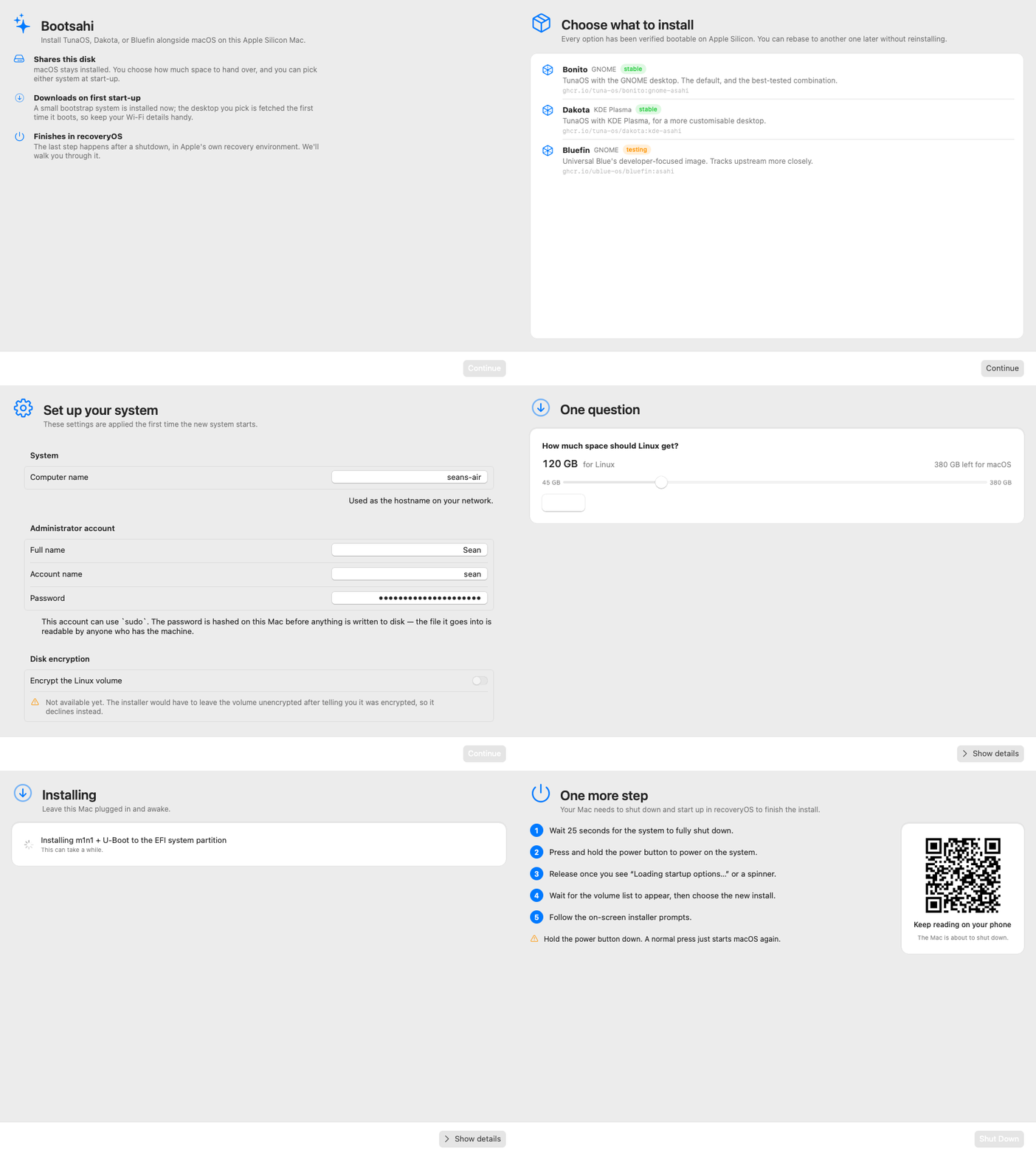
Every frame is rendered in CI from the real SwiftUI views — see the step-by-step walkthrough.
Architecture (see docs/DESIGN.md): instead of one
installer payload per variant×desktop, we ship one minimal bootstrap
payload whose first boot runs fisherman
to bootc install the image ref the user picked in the macOS app. The catalog
is just registry refs (bonito:gnome-asahi, …), so a new variant needs no
installer change — but a ref must pass the Asahi golden-manifest harness
before it is offered, and "appears without touching the installer" must never
be read as "appears without being verified."
As of 2026-07-30 only bonito and grouper pass (36/36 each); the other six
promoted *-asahi tags would leave a Mac unbootable
(tunaOS#776). The catalog
is an explicit allowlist: every CatalogEntry carries a verified field
(false by default), and the macOS app only offers entries where it is
true. The shipped catalog.json includes both bonito and grouper,
marked verified: true. Adding a new variant requires both the image and a
passing harness sweep — the field is the gate. That gate is currently
hand-maintained rather than CI-generated from harness results
(#70); the
harness sweep itself (#41)
that produced the two verified entries above is closed.
Contribute compute — no code needed
Your machine runs one task at a time using your signed-in AI coding CLI. The relay alternates between eligible School (OS) and Reef (apps) hives after each task. If one hive has no work, the other can continue.
The guide covers prerequisites, verified just setup, credentials, provider
costs, and how to stop with Ctrl+C. Your subscription quota or API charges apply.
Never post account credentials or API keys in issues or pull requests.
Status
- Design (docs/DESIGN.md)
- D0 scaffold:
scripts/make-payload.sh+build-payload.yml— package any asahi-capable bootc image as an asahi-installer zip +installer_data.json(wired with R2 upload step fordownload.tunaos.org/asahi) - D0 validated against a real asahi image (
bonito:gnome-asahi, tunaOS#774) - D1 first-boot fisherman agent config (
install-config.json→ unattendedbootc install) - D2 asahi-installer
--jsonmachine mode (upstreamable) - D3 macOS app (SwiftUI; implementation is complete, and CI build and tests pass). Alpha still needs end-to-end tests on real Apple Silicon and signed and notarized distribution.
- D4 recoveryOS: LUKS fails closed. Remaining work: illustrations, the final QR link target, Wi-Fi SSID prefill, real disk-slider bytes, hardware verification, and a signed and notarized release artifact.
Development & testing
Contributor workflow, code style, branch conventions and the full local test matrix live in CONTRIBUTING.md. The short version:
shellcheck -S warning scripts/*.sh components/*/*.sh   # lint, as CI runs it
sudo ./scripts/selftest.sh                             # payload + installer_data.json contract
./scripts/test-backend-contract.sh                     # pinned asahi-installer --json contract
./components/bootsahi-agent/test-agent.sh              # install-config.json -> recipe.json

cd macos-app/Bootsahi && swift build -v && swift test -v
What's tested and what it proves
The project distinguishes two claims that are easy to conflate (see #27):
| Claim | Test | What it proves |
|---|---|---|
| "A payload boots" | test-payload.sh + test-boot-payload.sh | The kernel, DTBs, modules, and U-Boot EFI chain work. Any asahi-capable image passes this — it proves the packaging, not the product. |
| "The bootstrap handoff is green" | test-agent.sh + test-agent-disk.sh + test-agent-install.sh | The agent generates a valid recipe, the recipe passes real fisherman validate, and a real bootc install succeeds end-to-end (canaries on ESP / neighbour / bootstrap / target). |
| "The bootstrap image contains everything it needs" | test-bootstrap-contents.sh | Static verification: bootsahi-agent, enabled unit, fisherman, cosign, jq, nmcli, blkid — all present and accounted for. Also gates a negative fixture (agent removed → must fail). |
| "The actual bootstrap image boots" | test-bootstrap-boot.sh (opt-in) | Build, package, and boot the repo's own bootstrap under qemu+U-Boot. The deepest fidelity achievable without Apple hardware. Needs aarch64 + qemu + u-boot-qemu. |
Payload layout & installer_data.json schema modeled on
fedora-asahi kiwi-descriptions and
nixos-asahi-package.
M1/M2 only — M3+ has no Asahi installer support yet.